White Label WhatsApp API: 2026 Business Guide
WhatsApp has become one of the most powerful tools for business communication today. Millions of companies use it to connect with customers quickly and easily. In fact, more than 50 million businesses rely on WhatsApp Business to chat with customers, share updates, and provide daily support. Because of this growing demand, many companies now use a white label WhatsApp API to offer branded messaging services and manage customer communication more efficiently.
Customers also prefer messaging over traditional channels. For example, people often ignore emails or SMS messages. However, they usually open WhatsApp messages almost immediately. Because of this behavior, WhatsApp delivers much stronger engagement. Business messages can reach open rates of up to 98%, while click-through rates can reach around 45%. Therefore, many companies now focus on chat-based communication instead of older marketing channels.
In addition, the white label WhatsApp API helps medium and large businesses manage conversations at scale. Companies use the white label WhatsApp API to automate replies, send alerts, and deliver customer support messages. Meanwhile, the white label WhatsApp platform connects easily with CRM systems and other business tools. As a result, teams manage customer communication more efficiently.
Today, more than 5 million businesses use the WhatsApp Business API to improve customer experience and streamline operations. Because of automation and integration, companies save time while also improving service quality.
Due to this rapid growth and strong engagement, the white label WhatsApp API has become a major business opportunity in 2026. Many agencies and SaaS companies now use a white label WhatsApp platform to launch their own branded messaging solutions. Instead of building complex systems from scratch, businesses can start quickly using the white label WhatsApp API.
Furthermore, this model allows companies to control their own pricing and onboard unlimited clients. As a result, businesses can scale faster and create recurring revenue streams. For agencies, resellers, SaaS companies, and enterprises, the white label WhatsApp API offers a practical way to grow while meeting the communication needs of today’s mobile-first customers.
What Is WhatsApp Business API White Label?
WhatsApp Business API White Label allows you to offer WhatsApp messaging services under your own brand. Instead of building a platform from scratch, you use an existing API infrastructure. However, you present everything as your own product.
In simple words, you sell WhatsApp automation, bulk messaging, and chat management using your domain and logo. Meanwhile, the backend provider handles the technical setup, Meta approvals, and infrastructure.
Therefore, you save time and cost. In addition, you launch faster without hiring developers.
A White Label WhatsApp Platform solution gives you:
- Your own branded dashboard
- Custom domain access
- Full pricing control
- Client management panel
- Automation and broadcast tools
On the other hand, if you build your own system, you must handle hosting, compliance, updates, and security. That process takes months. Moreover, it increases risk and expenses.
Because of this, agencies, SaaS companies, and resellers now prefer WhatsApp Business API White Label solutions.
How Does a White Label WhatsApp API Platform Work?
The process is simple and easy to manage. It lets you offer WhatsApp messaging services without building the technology yourself.
First, the provider connects you to the official WhatsApp Business API. Then, you rebrand the dashboard with your logo and custom domain. As a result, your clients see your brand when they use the white label WhatsApp platform.
After that, you create client accounts from your reseller panel. Each client receives their own login and WhatsApp number. Meanwhile, you manage all clients from one master dashboard.
Here is how the white label WhatsApp API works:
- You join a white label WhatsApp API partner program.
- You add your branding and custom domain.
- You onboard clients inside your white label WhatsApp platform.
- Clients send messages and run campaigns using the platform.
- You charge clients based on your own pricing plan.
Therefore, it gives you full control over pricing and revenue. In addition, clients only see your brand, not the backend provider.
Because of this model, businesses can build recurring income and grow easily with the white label WhatsApp platform.
Key Features Every WhatsApp Business API White Label Platform Must Have
If you want to build a successful white label WhatsApp API business, you must choose the right platform. However, not every provider offers the same level of control and flexibility. Therefore, you should focus on features that support branding, growth, and revenue.
Below are the most important features that every strong white label WhatsApp platform should include.
1. Complete Branding Control
A reliable white label WhatsApp API must support full branding options. This feature helps you present the platform as your own product.
You should be able to:
- Use your own domain
- Add your company logo
- Customize dashboard colors
- Remove the provider’s branding
As a result, clients see only your brand when they use the white label WhatsApp platform. Meanwhile, the backend provider stays hidden. Therefore, your business appears as the main service provider.
2. Multi-Client and Sub-Account Management
You must manage many clients from a single dashboard. Therefore, it should support multi-client management.
Important features include:
- Unlimited client account creation
- Separate WhatsApp numbers for each client
- Role-based access (admin, agent, manager)
- Credit or usage allocation control
In addition, the white label WhatsApp platform should track usage for each client. This feature helps you scale your service without technical problems.
3. Broadcast and Campaign Management
Businesses often use WhatsApp for marketing and updates. Because of this, it should include strong campaign tools.
Essential features include:
- Bulk message broadcasting
- Scheduled campaigns
- Audience segmentation
- Template message approval
These tools help clients send promotions, reminders, and product updates. Moreover, campaign automation increases engagement and improves sales results.
4. Automation and Chatbot Builder
Automation plays a key role in modern customer communication. Therefore, a strong white label WhatsApp platform should provide automation tools.
Important automation features include:
- Auto-reply messages white label whatsapp platform
- Chatbot flow builder
- Welcome messages
- Keyword-based triggers
As a result, businesses respond to customers faster. Meanwhile, they reduce manual work and operational costs.
5. Analytics and Reporting Dashboard
Data helps businesses improve their messaging strategy. Therefore, it should include a clear analytics dashboard.
Useful reporting features include:
- Message delivery reports
- Response and engagement tracking
- Campaign performance insights
- User interaction analytics
With clear data, clients understand the value of the white label WhatsApp platform. As a result, they remain long-term customers.
6. Flexible Pricing and Billing
Revenue depends on pricing control. Therefore, it should allow flexible billing options.
Key billing features include:
- Custom pricing setup
- Credit-based billing systems
- Subscription plan management
- Message usage tracking
Because of this flexibility, you can create different pricing plans for startups, agencies, or large businesses.
7. Official API Access and Security
Finally, it should use official WhatsApp Business API access. Unofficial solutions often create serious risks.
Official API access ensures:
- Account safety
- Compliance with Meta policies
- Secure message delivery
- Long-term platform stability
Security builds trust with your clients. Therefore, businesses feel confident using your white label WhatsApp platform.
These features create the foundation of a strong white label WhatsApp API business. Without them, scaling becomes difficult. However, with the right white label WhatsApp platform, you can grow your service steadily and build recurring revenue.
How to Get Started with LeminAI WhatsApp Business API White Label
Starting your white label WhatsApp API business with LeminAi is simple and structured. You do not need technical skills or server setup. Instead, you follow a clear process and launch your branded white label WhatsApp platform quickly.
Below is the step-by-step onboarding process.
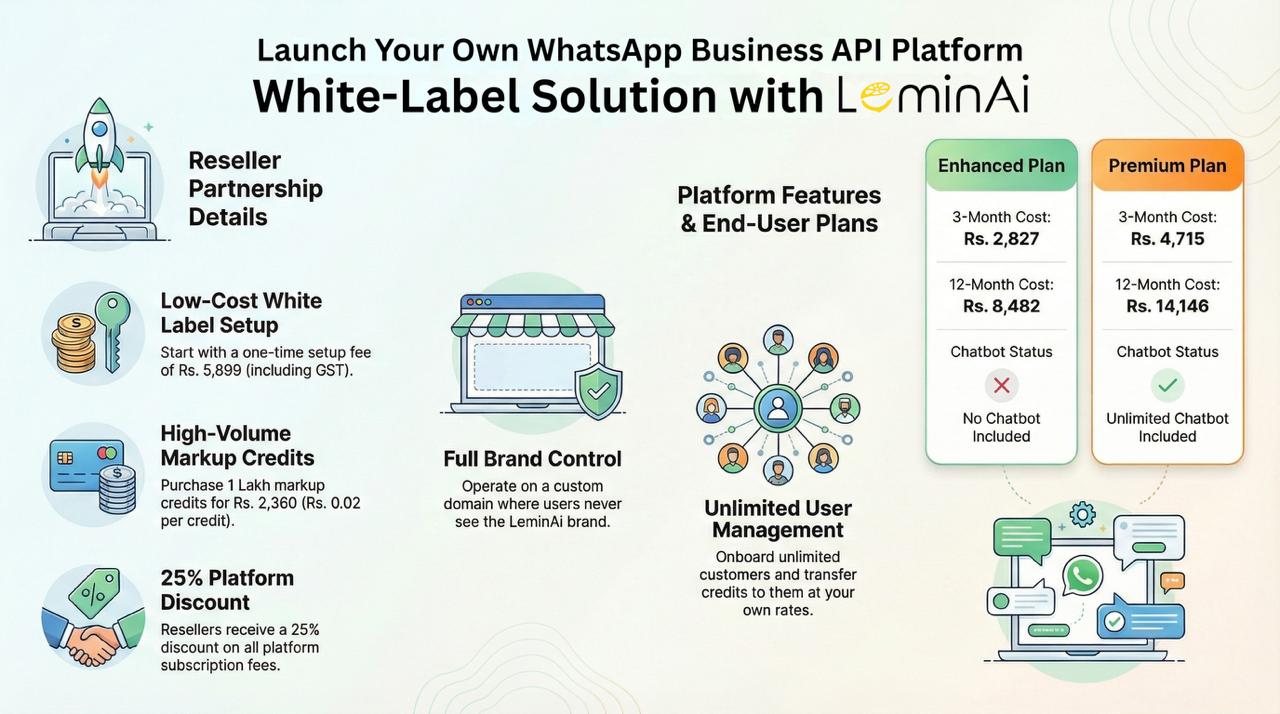
1. Pay the White-Label Setup Fee
First, you activate your partner account.
To begin, you pay:
Setup Fee: ₹4,999 + GST = ₹5,899
This one-time fee includes:
Full white label WhatsApp API panel setup
- Your branded dashboard
- Partner admin access
- Backend configuration
After payment, LeminAi prepares your white label WhatsApp platform. Therefore, you do not need to manage hosting, compliance, or API approvals.
2. Purchase Initial Markup Credits
Next, you buy credits to start onboarding clients.
1 Lakh Markup Credits: ₹2,000 + GST = ₹2,360
Cost per credit: ₹0.02
These credits help you start using the white label WhatsApp API immediately. Meanwhile, you can purchase more credits anytime as your client base grows.
This credit-based system provides flexibility and controlled scaling.
3. Configure Your Branding
Once your panel becomes active, you can fully customize it.
You can:
- Upload your company logo
- Set your brand colors
- Configure pricing settings
- Create subscription plans
As a result, clients see only your brand when they use the white label WhatsApp platform.
Meanwhile, LeminAi stays invisible in the backend. Therefore, you appear as the main service provider.
4. Set Your Subscription and Pricing Model
After setup, you can design your revenue strategy using the white label WhatsApp API.
You can:
- Set monthly subscription prices
- Decide message markup rates
- Create multiple plans (Basic, Pro, Enterprise)
- Offer custom packages for clients
For example, you may charge a higher price per message than the base ₹0.02 credit cost. The difference becomes your profit.
In addition, when a client buys a subscription plan, partners receive a 25% discount on the plan price. Therefore, this model increases your margins within your white label WhatsApp platform.
5. Start Onboarding Clients
Now your system is ready for business.
Using the white label WhatsApp API, you can:
- Create client accounts
- Allocate message credits
- Activate WhatsApp numbers
- Assign subscription plans
As soon as a client purchases a plan, you begin earning revenue.
Meanwhile, clients log in to your branded white label WhatsApp platform and start sending:
- Promotional broadcasts
- Automated campaigns
- Order notifications
- Customer support messages
All messages run through LeminAi backend API. However, billing and branding remain fully under your control.
6. Earn Recurring Revenue
The white label WhatsApp API model generates recurring income.
You earn revenue whenever clients:
- Renew subscriptions
- Use message credits
- Upgrade plans
You pay the base platform cost to LeminAi and keep your markup profit.
Meanwhile, the white label WhatsApp platform automatically tracks message usage. Therefore, you can monitor credits and manage accounts easily.
In addition, clients can add pay-as-you-go top-ups. This option allows them to scale gradually. At the same time, you continue earning from subscriptions and messaging usage.
Because of this structure, agencies, SaaS startups, telecom providers, and digital consultants can turn the white label WhatsApp API into a long-term and profitable messaging business in 2026 and beyond.
Who Can Benefit? Target Users of a WhatsApp API White-Label Solution
A white label WhatsApp API platform supports many types of businesses. It does not serve only one industry. In fact, it helps anyone who works in marketing, communication, automation, or client services.
If you already sell digital services, you can expand your offerings with the white label WhatsApp API. You can provide WhatsApp automation under your own brand and generate recurring revenue.
Below are the main users who benefit from a white label WhatsApp platform.
1. Digital Marketing Agencies
Digital agencies gain major advantages from this.
They can:
- Run WhatsApp marketing campaigns
- Offer chatbot automation
- Send broadcast promotions
- Manage customer support chats
Instead of recommending third-party tools, agencies provide WhatsApp services through their own white label WhatsApp platform. As a result, they can charge clients a monthly service fee.
For example, an agency that manages e-commerce brands can automate:
- Abandoned cart reminders
- Promotional broadcasts
- Lead nurturing messages
- Customer feedback requests
Moreover, the agency manages everything from one dashboard inside this.
2. SaaS Platforms and CRM Providers
Software companies can also benefit from it. They can add messaging features directly into their existing products.
For example:
A CRM system can include WhatsApp messaging
A helpdesk tool can add WhatsApp support tickets
A fintech app can send payment alerts through WhatsApp
Instead of building messaging infrastructure, these companies integrate a white label WhatsApp platform into their system.
As a result, they can provide:
Automated notifications
Transaction alerts
Two-way customer communication
Meanwhile, they avoid heavy development costs.
3. SMS and Bulk Messaging Resellers
Businesses that already sell SMS or email marketing services can easily expand with a it.
These companies already have:
Sales teams
Existing business clients
Distribution networks
Therefore, they can offer WhatsApp messaging as an additional service. By adding a white label WhatsApp platform, they expand their product portfolio.
As a result, they create a new recurring revenue stream without changing their core business.
4. Consultants and Freelancers
Independent consultants and freelancers can also use a white label WhatsApp API to build service offerings.
They can provide solutions such as:
WhatsApp order notifications
Appointment reminders
Customer support automation
Promotional campaigns
Many small businesses need automation but lack technical skills. Therefore, consultants can offer these services using a white label WhatsApp platform.
This model creates a low-investment and high-margin opportunity.
5. Industry-Specific Solution Providers
Some businesses focus on specific industries. For them, the white label WhatsApp API allows customized solutions.
Common industry examples include:
- Healthcare: appointment reminders
- Real estate: property listing updates
- Education: student notifications
- Finance: payment alerts
- Travel: booking confirmations
Because the white label WhatsApp platform is flexible, each industry can receive a tailored communication solution.
For example:
A healthcare consultant can automate appointment reminders.
A real estate tech partner can broadcast new property listings.
Final Thoughts
In simple terms, any organization that:
- Has an existing client base
- Works in marketing or communication
- Provides digital or automation services
can benefit from a white label WhatsApp API.
Because the entry cost is low and development is not required, both startups and established companies can adopt this model. Whether you run a small consultancy or a large agency, the white label WhatsApp platform helps you expand services, increase recurring revenue, and strengthen client relationships under your own brand.

.png)
Comments
Post a Comment